
Project Gagarin
As the middle of the twenty-second century approached the United Earth Science Federation's Project Symbiosis began to bear fruit. The damage our ancestors did to Earth's biosphere wasn't completely repaired, but hyper-cyclones were growing more and more rare. Extreme weather events had become manageable. In 2142 researchers at the Joint Institute for Nuclear Research successfully constructed a Higgs Attenuator. This device directly interferes with the Higgs Field, the underlying strata of reality that confers mass onto objects in the universe. This could be used to generate localized gravitation, alter the mass of objects arbitrarily, or bend spacetime to allow objects to travel faster-than-light. This, along with the technologies developed to support the Mars colonies: bioreactors to recycle organic material, water, and oxygen, advanced materials that insulate from radiation, and medical advancements to treat radiation sickness, made interplanetary travel more comfortable and sustainable. The UESF congress in 2144 ratified a bold new program: Project Gagarin.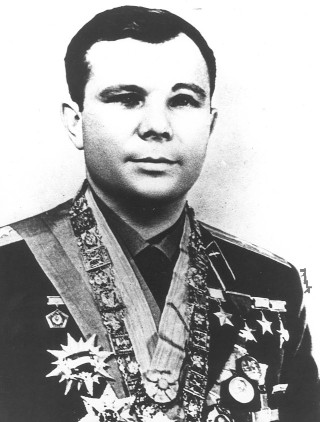 Named for Yuri Gagarin, the first human being to orbit Earth nearly two hundred years earlier, this new project would develop technologies to explore the greater galaxy and perhaps meet intelligent alien life. This program followed two major tracks. The first developed the Higgs Attenuator to reach it's full potential. The second developed technologies to provide a comfortable life for human explorers out among the stars.
The first major success for Project Gagarin was when the research department of the Brotherhood of Martian Workers provisionally joined Project Gagarin to aid in development of the habitation track in 2147. The team working on this track relocated to Mars and this improved relations between the worker's republic and United Earth.
The next major success for Project Gagarin was the launch of UES Laika on June 3rd, 2148. Laika was a testbed for faster-than-light technology and controlled by Reykjavik-3c23y. Laika traveled at 3C using the Higgs Attenuator to Proxima Centauri and returned to the Sol system.
As these technologies developed the separate tracks were gradually turned toward the ultimate goal of the project: to develop a vessel capable of carrying a large crew interstellar distances. Several designs were developed across the 2150's and ultimately it was decided that one of them balanced speed, comfort and safety. Construction of U3S Gagarin began in August 2158. Gagarin was built at the newly christened Vulcan Service Station at the Earth-Moon L2 lagrange point.
The first ship's congress was held May 10 through 11th 2160 in Cairo. Thomas Kafando, hero of the battle of the citadel and the Aphrodite Coup, was elected chairman of the ship nearly unanimously, two hundred sixty one to one. The second chair was Lei Xiu.
Starship Gagarin began it's shakedown mission on January 13, 2161. With a reduced crew compliment, the starship traveled to various destinations across the Sol system, including Mars, Venus, Europa and around the Kupier belt. It's technologies were tested and in the case of any deviations from expectations were brought into optimal operational parameters.
On April 12th 2161 U3S Gagarin was launched from Earth orbit and departed on it's mission to meet and befriend intelligent aliens.
As of the launch of Gagarin, two further Gagarin class vessels are under construction at VSS: The Thereskova and the Tamayo. Pending the success of Gagarin's mission, future name candidates for Gagarin class vessels include Yang, Liu, Shepherd, Tuân, Ride, Sharma, Bluford and Armstrong.
Named for Yuri Gagarin, the first human being to orbit Earth nearly two hundred years earlier, this new project would develop technologies to explore the greater galaxy and perhaps meet intelligent alien life. This program followed two major tracks. The first developed the Higgs Attenuator to reach it's full potential. The second developed technologies to provide a comfortable life for human explorers out among the stars.
The first major success for Project Gagarin was when the research department of the Brotherhood of Martian Workers provisionally joined Project Gagarin to aid in development of the habitation track in 2147. The team working on this track relocated to Mars and this improved relations between the worker's republic and United Earth.
The next major success for Project Gagarin was the launch of UES Laika on June 3rd, 2148. Laika was a testbed for faster-than-light technology and controlled by Reykjavik-3c23y. Laika traveled at 3C using the Higgs Attenuator to Proxima Centauri and returned to the Sol system.
As these technologies developed the separate tracks were gradually turned toward the ultimate goal of the project: to develop a vessel capable of carrying a large crew interstellar distances. Several designs were developed across the 2150's and ultimately it was decided that one of them balanced speed, comfort and safety. Construction of U3S Gagarin began in August 2158. Gagarin was built at the newly christened Vulcan Service Station at the Earth-Moon L2 lagrange point.
The first ship's congress was held May 10 through 11th 2160 in Cairo. Thomas Kafando, hero of the battle of the citadel and the Aphrodite Coup, was elected chairman of the ship nearly unanimously, two hundred sixty one to one. The second chair was Lei Xiu.
Starship Gagarin began it's shakedown mission on January 13, 2161. With a reduced crew compliment, the starship traveled to various destinations across the Sol system, including Mars, Venus, Europa and around the Kupier belt. It's technologies were tested and in the case of any deviations from expectations were brought into optimal operational parameters.
On April 12th 2161 U3S Gagarin was launched from Earth orbit and departed on it's mission to meet and befriend intelligent aliens.
As of the launch of Gagarin, two further Gagarin class vessels are under construction at VSS: The Thereskova and the Tamayo. Pending the success of Gagarin's mission, future name candidates for Gagarin class vessels include Yang, Liu, Shepherd, Tuân, Ride, Sharma, Bluford and Armstrong.
Sources
Minutes of the Thirteenth Congress of the United Earth Science Federation 2144/6/8-2144/6/15
Laika has reached Proxima Centari, Dragana Marković, Novi Sad Times 2156/2/19
August Status Report, Vulcan Service Station Engineer Committee 2158/9/1
Minutes of the First Convention of Starship Gagarin, 2160/5/10, 2160/5/12
Starship Gagarin launches to much fanfare, Hoang Nguyen, Nhân Dân 2161/4/13
Alphex Romulex
Vice Chair of Particle Physics
Aphrodite Complex School of Engineering
United Sol System Science Federation
Earth Date: May 21, 2161
Alphex Romulex
Vice Chair of Particle Physics
Aphrodite Complex School of Engineering
United Sol System Science Federation
Earth Date: May 21, 2161